
Can an Inmate in Wisconsin Legally Sign a Notarized Document in Milwaukee County CRC?
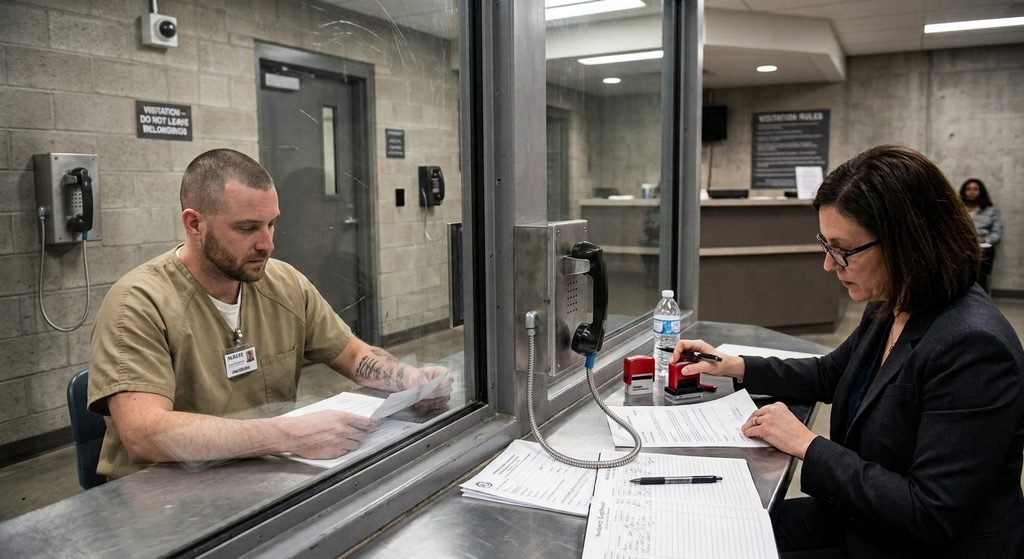
Yes. Being incarcerated in Wisconsin generally does not prevent a person from signing legal documents or having their signature notarized. An incarcerated individual may still need to handle important financial, property, family, and legal matters while in custody.
At the Milwaukee County Community Reintegration Center (CRC) in Franklin, Wisconsin, formerly known as the Milwaukee County House of Correction, residents may need access to a notary to sign documents while incarcerated.
The Milwaukee County CRC is a secure correctional facility for adult men and women located in Franklin, Wisconsin.
For families, attorneys, businesses, and others seeking a notarization, the process differs from simply scheduling an ordinary mobile notary appointment. The notary must work within the facility’s security procedures and visitation requirements.
What Is the Most Common Document We Notarize at the Milwaukee County CRC?
The Financial Power of Attorney (POA) is the most common document we are asked to notarize for individuals incarcerated at the Milwaukee County Community Reintegration Center.
A Financial Power of Attorney can allow an incarcerated person to appoint a trusted individual to handle certain financial and property matters on their behalf.
Depending on the authority granted in the document, this may include matters involving:
- Bank accounts and financial institutions
- Bills and other financial obligations
- Real estate or property
- Insurance matters
- Vehicles and titles
- Contracts and business matters
- Government benefits
- Taxes and financial records
- Other financial transactions authorized by the document
The person granting the authority is generally called the principal, while the person receiving the authority is called the agent.
Wisconsin Provides a Free Financial Power of Attorney Form
Families do not necessarily have to purchase a Financial Power of Attorney form.
The Wisconsin Department of Health Services (DHS) provides an official Power of Attorney for Finances and Property (Form F-00036) that is available online. DHS explains that its advance-directive forms use standard wording from Wisconsin law and, when properly completed and signed, are recognized as valid in Wisconsin.
Download the Wisconsin Power of Attorney for Finances and Property form from Wisconsin DHS
The form should be reviewed carefully before it is signed. A Power of Attorney can give another person substantial authority over someone’s money and property, so the person signing should understand what powers are being granted and whom they are appointing.
For situations involving complicated property, business, estate-planning, or family issues, an attorney may be appropriate.
Does a Wisconsin Financial POA Have to Be Notarized?
Wisconsin’s state Financial Power of Attorney form specifically states that signing before a notary is not required, but it also explains an important reason people choose notarization: an acknowledged signature creates a legal presumption of genuineness and may make the document easier for businesses and financial institutions to accept.
This can be especially important when a POA will be presented to a bank, title company, government agency, or another organization that needs confidence that the incarcerated individual actually signed the document.
Can a Notary Go to the Milwaukee County CRC in Franklin?
A correctional-facility notarization is different from a standard mobile notary visit.
The signer cannot simply meet the notary at a home, office, or coffee shop. Access is controlled by the correctional facility, and the visit must comply with the Milwaukee County CRC’s current procedures and security requirements.
Before arranging the visit, it is helpful to have as much information as possible, including the resident’s:
- Full legal name
- Resident or booking information, when available
- Document that needs to be notarized
- Any instructions from the attorney, bank, title company, or organization requesting the document
If a document needs witnesses in addition to notarization, that should also be identified before the notary visit is scheduled. Witness requirements are separate from notarization requirements, and access to additional people inside a secure correctional facility can require advance planning.
What Does the Notary Do?
A notary does not decide whether an incarcerated person should sign a document and does not provide legal advice about what the document should say.
Instead, the notary performs the appropriate notarial act. Depending on the document, this can include verifying the signer’s identity, confirming the individual’s appearance before the notary, completing the required notarial certificate, and applying the notary’s signature and seal.
The signer must also be able to communicate with the notary and participate appropriately in the notarization.
If you are unsure which document the incarcerated individual needs, you may need to speak with an attorney or the organization requesting the document before arranging the notary appointment.
Other Documents That May Need Notarization at the Milwaukee County CRC
Although a Financial Power of Attorney is the document we see most frequently, an incarcerated individual may need many different documents notarized.
These can include affidavits, sworn statements, real estate documents, deeds, vehicle-related documents, authorization forms, estate documents, business documents, and other legal paperwork.
The exact requirements depend on the document and the purpose for which it will be used.
Don’t Have the Document Yet?
If your loved one needs a Financial Power of Attorney and you have not been provided one by an attorney, the official Wisconsin DHS Power of Attorney for Finances and Property (F-00036) may be a useful starting point.
Wisconsin DHS makes the form available online, and it can be printed before arranging the jail notary visit.
View Wisconsin DHS Power of Attorney and Advance Directive Forms
Be sure to print and review the entire document. DHS cautions that its forms should be completed and signed properly and that the preprinted language should not be changed except where the instructions permit it.
Need a Notary at the Milwaukee County CRC in Franklin?
Arranging a notarization for someone who is incarcerated can feel complicated, especially when an important financial or legal matter cannot wait until the individual is released.
Wisconsin Jail Notary provides professional mobile notary services for individuals incarcerated at the Milwaukee County Community Reintegration Center in Franklin, Wisconsin.
We work with family members, attorneys, businesses, and other authorized parties who need documents notarized by an individual currently in custody.
Whether you already have a Power of Attorney, affidavit, property document, or other legal document ready for signature-or you are trying to understand the notary-visit process-we can help make arranging the notarization easier.
Need a document notarized at the Milwaukee County CRC? Contact Wisconsin Jail Notary to arrange a professional correctional-facility notary visit.
This information is provided for general informational purposes and is not legal advice. A notary public cannot select or prepare legal documents for you unless separately authorized to do so. For questions about what document you need or the legal effect of a document, consult a qualified attorney.